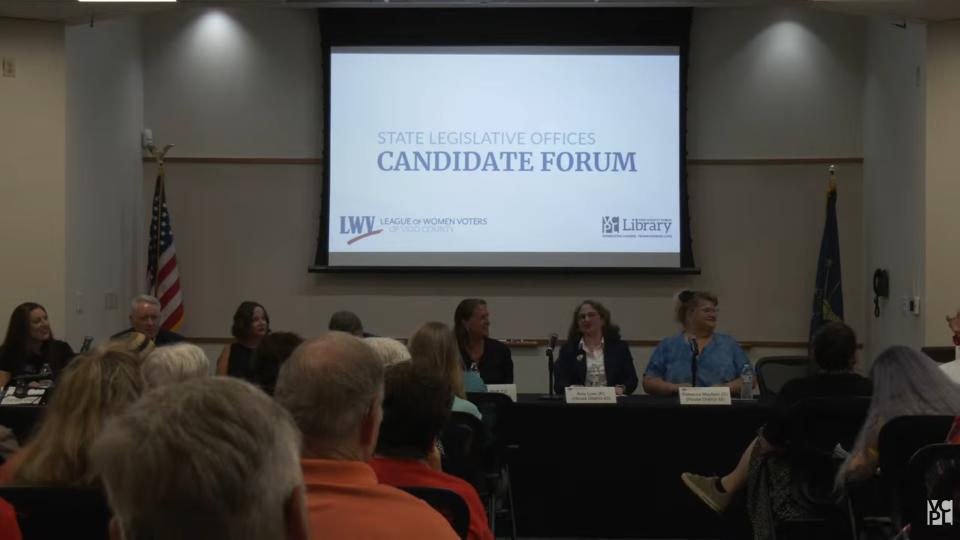
State legislative candidates representing the Wabash Valley offered differing views on data centers during a recent candidate forum at the Vigo County Public Library hosted by the League of Women Voters, with concerns ranging from infrastructure and land use to taxation, natural resources and local control.
None of the candidates who spoke on the issue opposed data centers. Instead, their responses focused largely on how communities and state government should approach the facilities, including questions surrounding land use, infrastructure, taxes and the ability of local governments to determine whether a project is appropriate for their communities.
Republican Sen. Greg Goode compared data centers to other large-scale industrial developments, arguing that communities need to consider how those developments fit with surrounding land uses.
“Data centers are no different than a steel mill, or a massive hog operation, or a landfill, or any other industry,” Goode said. “It’s a way of life and we just need to be smart about the way we use our land.”
Goode’s Democratic opponent, Kacey Blundell, also acknowledged that data centers play a role in the technology people use every day, but she called for greater caution as communities consider large-scale projects. “Data centers I fear are a necessary evil. I, like many of you, use my cell phone every single day, but we need to pump the brakes.”
In House District 42, Democrat Brandi Vandivier responded, “We all do use data centers but there’s a difference between traditional data centers and these larger AI data centers.”
Her Republican opponent, Tim Yocum, placed his emphasis on local control, saying county officials and residents should ultimately have the ability to reject a proposed development. “Totally a local decision, and if you don’t want it, and the county don’t want it, then say no.”
The candidates in House District 43 approached the issue from different directions. Democratic incumbent Tonya Pfaff focused on the tax treatment of data centers, arguing that the facilities should be subject to sales taxes similar to those paid by other electricity customers.
“At the very, very, very, least these data centers should be paying 7% sales tax like we all do in this room,” Pfaff said. “If you look at your electric bill you’ll see that you’re paying 7% sales tax…the data centers don’t.”
Republican Amy Lore focused on balancing concerns about resources with potential economic-development opportunities. Lore called for “reasonable forward motion” that includes “adequate respect for our resources but also not boxing ourselves out of economic development opportunities.”
House District 45 candidate Rebecca Mayfield raised concerns about whether existing infrastructure is prepared to handle major data center projects, pointing specifically to aging infrastructure in communities across the area.
“I know our community is not the only one out there with weakened old infrastructure,” Mayfield said. “I think the infrastructure stuff needs to be addressed before we even look at putting data centers in.”
The discussion reflects the growing questions surrounding data center development as Indiana communities consider projects that can require significant amounts of land, electricity and supporting infrastructure. For Wabash Valley voters, the candidates’ responses offer differing approaches to what role state lawmakers and local governments should play as those projects are considered.



Leave a Reply